Upzoning Legislation Pending at the Board of Supervisors

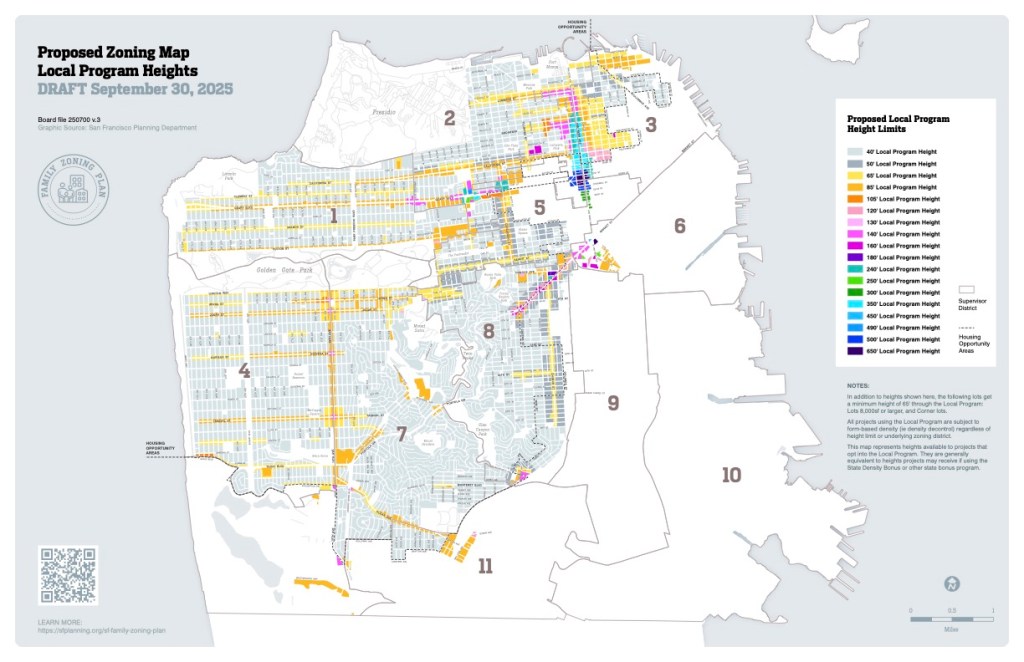
The legislation codifying the proposed upzoning map and specific code changes is pending at the Board of Supervisors.  These changes will have a major impact on San Francisco’s built environment over this and the coming decades.  To see the proposed heights for your and adjacent properties review the Family Zoning Plan map with the “Local Program” heights.  Developers can “opt in” to this program as opposed to participating in the State Density Bonus program.  Besides increased heights, the SF Local Program provides key revised objective standards that allow more density on a lot. 

The impact of the Family Zoning Plan is the de facto elimination of the 45 year old Dolores Heights Special Use District.    

  • Our heights are currently 35; new heights allowed  can be 40, 50, or 65 feet.  
  • The rear yard open space is currently 45% of the lot depth, or 51 feet for a 114 foot lot.  The plan allows new properties to expand 20 feet further into the rear yard (18% more of the lot depth), eroding our unique mid-block open space benefits
  • Properties on any corner can be up to 65 feet high.  This 65-foot height also applies to lots that are 8000 square feet (less than the size of three merged standard lots or an apartment building-sized lot.)
  • Other recent amendments that allow for height and square footage “bonuses” and more rear yard reductions, some for defined changes and a a “catchall” request for up to 15% reduction of any objective standard 

DHIC is opposed to the plan in its current form as it provides significant benefits to market-rate developers without comparable benefits to SF’s Housing Plan – especially for more affordable (from moderate to very low income) housing units.  DHIC is also concerned that historic buildings aren’t sufficiently protected and that tenants and small businesses can be displaced with inadequate relocation benefits.  This SF Planning website has more documents to educate the public.  However, it doesn’t assess the impact of all these combined changes on our neighborhoods. 
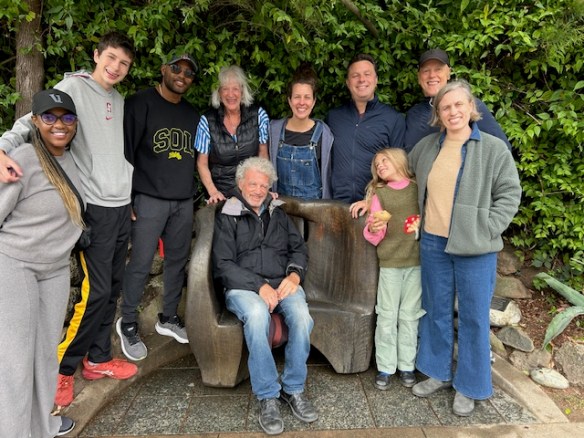
Audrey’s Bench on Sanchez Hill

The beautiful redwood bench on Sanchez Street near the corner of 21st is dedicated to Audrey Rodgers, received a cleaning and refresh from her family members on Saturday, August 2.

Audrey Rodgers, the DHIC chair from the late 70s through early 80s, led the campaign to have Dolores Heights designated as a Special Use District in the planning code.  Audrey understood Dolores Heights’ unique characteristics that drew people to walk and enjoy its green spaces and dramatic views. She realized that citywide rezoning proposed in the late 70s would “flatten” the hills and reduce the midblock open spaces.  So she and other leaders organized for months to preserve the space and vistas where future generations have lived, enjoyed, and raised their families.

The Dolores Heights Special Use District that Audrey and other neighbors successfully got the City to enact into law in 1980.  It will be overridden by the proposed upzoning described in the article above. If you agree that we should sacrifice the many unique characteristics in San Francisco for a massive upzoning for development, please email our supervisor and mayor.  

Upzoning Legislation Hearing – September 11

You should have received a postcard from SF Planning – with a QR code link to the proposed height and other zoning changes.  DHIC urges you to read details below and on the SF Planning site.  This proposed “rezoning of height and/or density” entails the most extensive and highest-impact changes possibly in the history of San Francisco’s planning code.  The plan will significantly affect Dolores Heights (expand this interactive map to ID changes to your lot.)  DHIC opposes this excessive upzoning.  We urge Dolores Heights residents to express your opinion to our elected officials  including our supervisor, Rafael Mandelman, and Mayor Lurie and to attend the Sept 11 hearing at 12 noon at City Hall, Room 400.  Following the Planning Commission hearing, the Board of Supervisors will vote on the proposed legislation to enact the “Family Zoning Plan” this fall.

State law and SF’s 2022 Housing Element require the City to create more “capacity” for housing.  The City has chosen to upzone roughly two-thirds of our City with new heights, density, and other planning code changes. These proposed changes have significant impacts on Dolores Heights.   

What will change in Dolores Heights?    

  • Our heights are currently 35 or 40 feet; the new allowed heights will be 40, 50, or 65 feet.  
  • The rear yard open space is currently 45% of the lot depth or 51 feet for a 114 foot lot.  The plan allows new properties to expand 20 feet further into the rear yard (18% more of the lot depth)
  • Properties on any corner can be up to 65 feet high.  This 65-foot height also applies to lots that are 8000 square feet (less than the size of three merged standard lots or an apartment building-sized lot.)     

Say hello to 50 foot buildings on many DH streets, to 65 foot buildings on corners, and to adjacent buildings that extend 20 feet past your home’s rear wall.  For specific proposed heights for your home, expand this interactive map.  You will see two heights “Base” and “Local Program.”   “Base” height will be the “new” allowed heights.  The “Local Program” height is often higher than the “base” height. To build higher and bigger in Dolores Heights, an owner or developer can “opt into” the local program and receive the benefits bulleted above. 

DHIC opposes this strategy to upzone hundreds of thousands of SF properties for several reasons.  

  • Overkill:  To meet its state housing mandate, San Francisco only needs to approve 36,200 additional projects by 2032 … not hundreds of thousands of projects  
  • Not affordable:  80% of newly proposed projects must be affordable housing. Yet, inclusionary units required under this program and other affordable subsidies will not produce the 28,700 affordable units needed to meet the state mandate. (Read this SF Planning primer for details.)  
  • Not financially feasible:  SF Planning’s own feasibility study modeled the impact of these changes and found that under current economic conditions, no project would meet minimum profitability.  With slightly improved economic assumptions, then multi-unit projects with apartments averaging 866 sf and renting for $4600 monthly would be profitable. (see pages 34 – 63 of SF Planning memo to SF Planning Commissioners, dated June 26, 2025)
  • Tenant/small biz displacement: Church Street and 24th Street are proposed for 65 foot heights along with most other NCDs.  Most renters and small local businesses on these streets that are displaced by new construction won’t be able to afford the new rents.   

What can we do?  DHIC is part of Neighborhoods United SF (NUSF.net ) which opposes the plan and advocates for alternative strategiesYou can write or call the Mayor to express your views on the plan. Questions? Feedback?  Or if you’d like to come with us to the Sept. 11 hearing, email DHIC at info@doloresheights.org  

For more details and the full list of proposed changes, see SF Planning memo, June 26, 2025, page 16 – 19, Figure 6.  DHIC is part of Neighborhoods United SF (NUSF.net ) which opposes the plan, provides factual arguments relating to its shortcomings, and advocates for reasonable changes to the plan

Update on Upzoning

San Francisco Planning has nearly completed its years-long project to meet the quota of 82,000 new housing units imposed on us by the State.  (For more information read this primer from SF Planning.)  The City’s response is to upzone nearly two-thirds of the City’s residential lots – from Glen Park/Noe Valley to the northeast/northside and all the areas west of Twin Peaks.  (See this interactive map with the Lurie Administration’s “Family Zoning Plan” proposed heights.)  This blanket upzoning plan includes “waivers” of key planning code requirements – such as current rear yard setbacks and added height bonuses for some blocks and for corner and large properties. 

How does this affect Dolores Heights?  The table on the DHIC website summarizes the key changes that can be incorporated into new housing projects in our neighborhood. Say hello to 65 foot buildings on corners and to adjacent buildings that extend 20 feet past your home’s rear wall.  

DHIC opposes this strategy to upzone hundreds of thousands of lots to meet SF’s goal of only 36,200 additional projects by 2032.  And 80% of these projects must be affordable housing (see the primer linked above); however, inclusionary units and subsidies fall short of meeting this goal.

What’s next? On June 24 Mayor Lurie introduced legislation amending the Planning Code rules to incorporate the provisions of the Family Zoning Plan. It will be heard at the Board of Supervisors during the summer and likely voted on in early Fall.   

Upzoning: Impact on Dolores Heights 6/24/2025

Incentivizes significantly taller/longer buildings with negative impacts on open space and public views

Zoning  ElementDH SUD – the way it’s been since 1980Proposed Upzoning – the way it will be for multi-unit projects
Height35 feet height throughout the Dolores Heights Special Use District (DH SUD)40 feet – 65 feet heights – see SF Planning map for heights by street, plus up to 50’ on blocks east of Sanchez and north of 20th St.More changes – height, length, etc. below
Impact: taller buildings – 40 feet up to 65 feet, and 50 feet on some blocks – will cast more shadows on nearby homes, reduce public views, and degrade the view of Sanchez Hill.  See proposed map
Rear yard setback45% of lot depth  For a standard Dolores Heights lot (114’ deep), required rear yard: 51 feet Reduce current setback by 18% of lot depth: For a lot depth of 114 feet, required rear yard reduced to: 30.5 feet,
Impact: buildings can extend 20 feet further into the rear yard than the adjacent homes – reducing neighbors’ light, privacy, & the midblock open space in Dolores Heights.
Additional height allowedNoneCorner lots and lots > 8000 sq feet can add two stories, up to 65 feet height. 50 feet allowed on lots east of Sanchez and north of 20th.
Impact: Regardless of “base height”, properties on a corner or on a 8000 sf lot anywhere in Dolores Heights can build to 65 feet height – casting shadows and blocking public views up & down Sanchez Hill   
Project reviewHearings for variances and some demolitions“Ministerial” review: in many cases, no appeal rights or hearing if project meets standards
Impact: New buildings can be approved with no notice to neighbors or hearing to assess impact on neighbors or the neighborhood.  

What can we do?  DHIC is part of Neighborhoods United SF (NUSF.net ) which opposes the plan and advocates for alternative strategiesYou can write or call the Mayor to express your views on the plan. 

Neighborhood Notification of Proposed Upzoning Required by Board of Supervisors

On Tuesday, April 22 the Board of Supervisors approved legislation requiring direct notice to residents and businesses when their own property, or one within 300 feet of it, is proposed for upzoning.  Specifically, it requires a mailed notice of increases in height and/or density.  The measure passed with an 8–3 supermajority!  Our supervisor, Rafael Mandelman, voted for this notification.

What does this mean for Dolores Heights?  All of Dolores Heights is proposed for increased building heights (see article above for details.)  So SF Planning will mail all of us that postcard before the Board of Supervisors acts on the proposed upzoning legislation this fall.   

The Impact of Lurie’s “Family Zoning” Plan on Dolores Heights

The City released a new proposed upzoning map on April 8.  Height limits in Dolores Heights would increase from 35 feet to 40 feet west of Sanchez, up to 50 feet in most of the area east of Sanchez, and up to 65 feet for properties along Church Street.  In addition, the proposal eliminates controls on density, or number of units per lot.  In other words, a project’s height and volume are regulated, but the number of units on a site is not limited to (for example) one or two units.

This interactive map provides details for Dolores Heights and for your own property.  Expand the map to zero in on your lot.  Click on the lot and a pop-out text box provides details.  Based on recent State and City changes to the rules, in most cases, you as an adjacent homeowner would have no input or no appeal rights on a proposed project. 

Specifically, Church Street can have multi-unit buildings up to 65 feet tall (current height limit: 40 feet.)   Between Church and Sanchez Streets, multi-unit buildings can be 50 feet high (current height limit: 35-40 feet.)  For the remainder of Dolores Heights, the allowed height would increase 40 feet. These changes will have a significant impact on public views and the view of Sanchez Hill from Dolores Park or from 24th Street.  This blog provides computer-generated models showing the impact of proposed height changes along Church Street.  While this program is being marketed as providing more affordable housing, during the past ten years in Dolores Heights, only luxury housing has been constructed.  This trend will continue owing to land prices.    

If you disagree with this blanket upzoning in our neighborhood and in most of the City, you can email the Mayor and our Supervisors by completing this email.  For more information, email info@doloresheights.org.  

Neighborhood Notification of Proposed Upzoning Required by Board of Supervisors

On Tuesday, April 22 the Board of Supervisors approved legislation requiring direct notice to residents and businesses when their own property, or one within 300 feet of it, is proposed for upzoning.  Specifically, it requires a mailed notice of increases in height and/or density.  The measure passed with an 8–3 supermajority!  

What does this mean for Dolores Heights?  All of Dolores Heights is proposed for increased building heights; so all of us will receive that postcard.   

Supervisor Chan (D1) sponsored this ordinance. These supervisors agreed with her that the public has a right to know of proposed changes that affect them: Sherrill (D2), Sauter (D3), Engardio (D4), Mandelman (D8), Fielder (D9), Walton (D10), and Chen (D11).

Attend D8 Town Hall on Upzoning – Monday, September 9 at 6 pm

In November 2023, the SF Planning Department published this current proposed map which doubles height limits along Church Street, 24th Street and other areas of District 8.  Combined with SB 423’s “ministerial” approval of residential projects (see article below), it opens the door to tall luxury condos and hinders the construction of affordable housing.  To learn why upzoning is the wrong solution for D8 (& SF), come to the D8 Town Hall on Housing sponsored by DHIC and other D8 neighborhood groups on Monday, Sept. 9 at 6pm at the Noe Valley Ministry (1021 Sanchez Street.)

Want to know more now?  The proposed map was driven by the State’s mandate that SF produce 82,000 new housing units by 2031.  But wait, San Francisco has over 73,000 permitted projects in its pipeline, including 16,000 affordable units. And in 2022, the Board of Supervisors up zoned – allowing four-plexes on single family lots and six-plexes on all residential corner lots – creating capacity for over 480,000 more housing units.  Moreover, the State Density Bonus law provides additional height when projects include at least 10% affordable units.  

So where’s the housing shortage?  The SF Planning Department has since announced that SF only needs 36,200 additional housing units (beyond those in the pipeline.)  However, 80% of these need to be affordable housing.

San Francisco doesn’t lack sites for housing.  It lacks subsidies for affordable housing and favorable interest rates and construction costs for market-rate housing. Cities themselves do not construct housing.  Instead, they issue permits for housing projects. Current economic factors and lack of affordable housing subsidies, rather than zoning restrictions, primarily influence the slow pace of construction in San Francisco.

Simply put, an “upzoning” plan to double height limits and disregard public input is radical and will not benefit the city’s residents or small businesses. Rather, such moves would destroy our neighborhoods and displace the people and local businesses that make San Francisco special. A top-down, one-size-fits-all approach to zoning undermines the vibrant character of our amazing neighborhoods. 

Attend the D8 Town Hall on Housing – Monday, September 9 at 6pm at the Noe Valley Ministry.